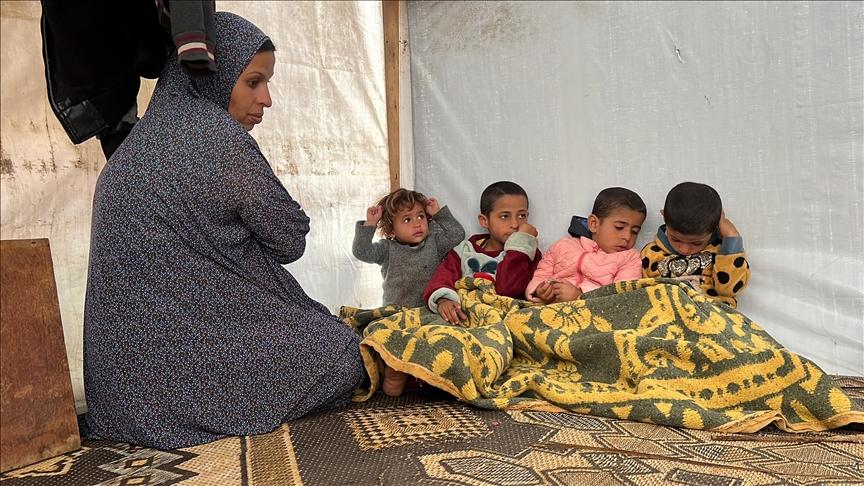
Winter’s Fury in Gaza: Storms, Blockades, and a Struggle to Survive
Torrential rain and Israeli aid restrictions leave Gaza’s displaced families battling hypothermia and hunger as humanitarian deliveries plummet.
Winter’s Fury in Gaza: Storms, Blockades, and a Struggle to Survive
By Elena Vance, Senior International Correspondent
Gaza City—Nightfall on Saturday brought more than darkness. A bruised sky cracked open, loosing torrents of rain that turned alleyways into canals and tents into bathtubs. By dawn, three children had died of hypothermia, according to medics at Al-Shifa Hospital, their tiny bodies unable to fight the cold that seeped through plastic sheeting already shredded by earlier bombings.
‘We are drowning in the cold’
In the courtyard of what was once an elementary school in Gaza City, 47-year-old Reem Abu Halima used a cracked teacup to bail water from the corner of a classroom now housing 42 relatives. “We are drowning in the cold,” she said, voice hoarse from three nights without sleep. “The rain comes through the roof, the blankets are wet, and the world watches on television.”
“My grandson keeps asking why the moon is angry at us. I have no answer.”—Reem Abu Halima, displaced grandmother
Aid convoys stalled at the crossing
While the storm raged, Israeli officials kept the Rafah crossing closed for a second consecutive day, citing security assessments. United Nations trucks loaded with blankets, fuel, and high-calorie biscuits idled on the Egyptian side, their drivers sipping cardamom coffee against the chill. The UN Relief and Works Agency (UNRWA) says 89 trucks have been denied entry since Friday, slicing daily humanitarian deliveries to roughly one-third of pre-war levels.
- Only 92 aid trucks entered Gaza on Sunday, against a pre-war average of 500.
- Fuel reserves for hospitals stand at 24 hours, according to the Gaza Health Ministry.
- Some 1.9 million people—85 percent of the population—are internally displaced.
‘The storm is not natural; it is manufactured’
Dr. Majed Abdel-Rahman, a pediatrician at Al-Aqsa Hospital in Deir al-Balah, treated six cases of severe hypothermia in 12 hours. “We lack pediatric warming pads,” he said, gesturing toward a corridor where IV bags hang from makeshift hooks fashioned from coat hangers. “When you close borders, when you restrict electricity, when you forbid wood for fires, the storm is not natural; it is manufactured.”
Israel’s Coordinator of Government Activities in the Territories (COGAT) reiterated Sunday that “there is no limit on humanitarian aid,” blaming the shortfall on “logistical failures by UN agencies.” The claim is flatly rejected by humanitarian officials who point to scanned manifests showing rejected shipments of chlorine tablets, water bladders, and dialysis fluids—items not on Israel’s dual-use list.
Desperation in the rubble
In Khan Younis, 23-year-old Mahmoud Al-Louh scavenged timber from the splintered remains of a bombed café, loading scraps onto a donkey cart. “We burn everything—doors, books, even plastic,” he said. “The smoke burns our lungs, but the children must feel some warmth.”
The Palestinian Central Bureau of Statistics reports that 68 percent of Gaza’s 2.3 million residents now rely on open fires or small electric heaters powered by rooftop solar panels—many of which were damaged in last week’s bombardment. Fire-related injuries have tripled since December, medics say.
International reaction
White House National Security Advisor Jake Sullivan told CNN the United States is “pressing Israel to facilitate winter-specific aid,” while the European Union’s foreign policy chief Josep Borrell called the situation “a man-made humanitarian calamity.” Yet inside Gaza, diplomatic statements ring hollow against the howl of wind rattling corrugated tin.
Back at Al-Shifa, a nurse wrapped the body of a four-year-old girl in a blood-stained blanket; the morgue’s refrigeration unit stopped working two days ago. “We no longer have the luxury of grief,” the nurse said. “We move to the next patient, and the next, until the storm—or the policy—changes.”