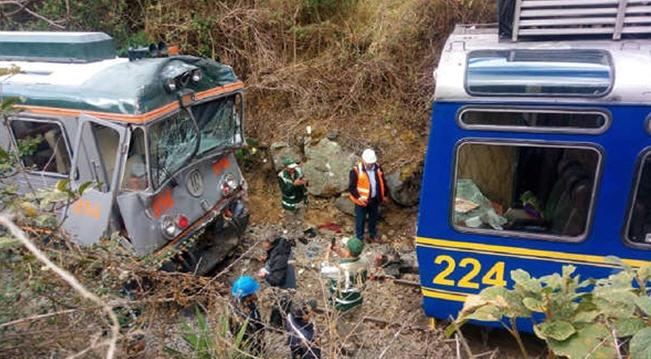
Train crash near Machu Picchu leaves one dead, dozens hurt
A landslide derailed a tourist train outside Machu Picchu, killing one and injuring 43, reigniting safety fears on Peru’s most famous rail route.
Deadly derailment on the route to Peru’s famed ruins
CUSCO, Peru — A crowded tourist train bound for the ancient citadel of Machu Picchu lurched off the rails Tuesday morning, killing at least one passenger and injuring 43 others, officials confirmed. The accident occurred at Kilometer 82 of the Urubamba–Aguas Calientes line, a narrow ribbon of track that threads the cloud-forested gorge below the Incan sanctuary.
‘It felt like the world folded in half’
María Elena Ríos, a nurse from Madrid on her honeymoon, was sipping coffee in the observation car when the carriage began to sway violently. “The windows exploded inward, and suddenly we were sliding on gravel,” she recalled, her bandaged wrist trembling. “People were screaming in six languages.”
We were sliding on gravel. People were screaming in six languages.
— María Elena Ríos, passenger
PeruRail, the private operator that runs the service, said the lead locomotive struck a landslide that had spilled onto the track after pre-dawn rains loosened the steep Andean slope. The engine jackknifed, pulling two passenger cars downslope toward the churning Vilcanota River. Quick-thinking train staff yanked emergency brakes, preventing the entire consist from plummeting some 40 meters into the water.
Race against the setting sun
Rescuers arrived within 45 minutes, rappelling down the embankment to reach dazed tourists wedged between seats and luggage. Helicopters ferried the most critically injured to a trauma hospital in Cusco, while others were treated in a makeshift triage center set up inside the 16th-century church of Ollantaytambo.
- Fatal victim identified as 26-year-old Argentine tourist Valentina Gómez.
- Among the injured: 19 foreign nationals from the U.S., Brazil, France, Japan, and Australia.
- Five passengers remain in serious but stable condition with spinal and cranial trauma.
Transport Minister Raúl Pérez-Reyes told reporters that the line would remain closed for at least five days while engineers inspect every tie and signal. “We will not gamble with lives,” he vowed, brushing aside questions about past warnings of geological instability in the area.
A fragile lifeline to the past
Built in the 1920s to haul silver ore, the 30-kilometer spur to Machu Picchu has become a lifeline for more than 1.2 million visitors each year—tourists who spend roughly $700 million in the region. Locals fear the crash will scare travelers away at the start of the high season, dealing another blow to an economy already bruised by pandemic shutdowns.
Back in Aguas Calientes, the gateway village below the ruins, souvenir vendor Luzmila Ccapa stacked alpaca sweaters untouched by shoppers. “We survive because the trains keep coming,” she said, eyes fixed on the dormant railhead. “If they stop, so do we.”