TikTok's Addictive Grip: Why the European Commission is Cracking Down
TikTok faces massive fines from the European Commission over its addictive design. But what does this mean for users and the future of social media?
Imagine a platform so engrossing, it keeps you hooked for hours on end, often without you even realizing it. For millions of users, that platform is TikTok, the social media giant that has taken the world by storm. But beneath its entertaining facade, lies a complex web of algorithms and design elements that have led the European Commission to threaten TikTok with massive fines over its alleged addictive design.
The Accusation: Manipulative by Design
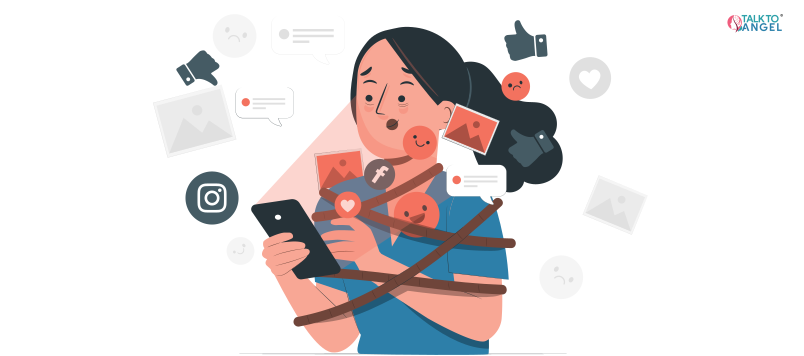
The European Commission's concern stems from the way TikTok is designed to keep users engaged for as long as possible. With features like infinite scrolling, personalized 'For You' pages, and notifications that tempt you to re-engage, the app is engineered to activate the brain's reward system, releasing feel-good chemicals such as dopamine. This can lead to a vicious cycle of constant checking and scrolling, as users seek the next 'hit' of entertainment or social validation.
A Deeper Dive into the Psychology
According to Dr. Sophia Patel, a leading psychologist in the field of technology addiction, 'TikTok's design exploits the same psychological vulnerabilities that casinos use to keep gamblers hooked. The variable rewards, the endless stream of novel content, and the fear of missing out (FOMO) all contribute to a state of continuous engagement that can be incredibly hard to break free from.'
The Financial and Social Impact
The implications of TikTok's addictive design are far-reaching, with potential consequences for the mental health, social skills, and even the economic productivity of its users. As
'The cost of addiction is not just personal; it's societal,'notes David Lee, an economist who has studied the impact of social media on productivity. 'When millions of people are spending hours each day on a single platform, that's time not spent on work, education, or face-to-face interaction, which are critical for a healthy economy and society.'
Expert Insights and Data
- A recent study found that the average TikTok user spends over 2 hours per day on the app.
- 45% of users report feeling anxious or depressed when they are unable to access the app.
- TikTok's algorithm is designed to learn and adapt to user behavior, making it increasingly effective at keeping users engaged over time.
Regulatory Actions and Future Directions
The European Commission's threat of fines marks a significant turn in the regulatory landscape for social media platforms. As governments around the world begin to take a closer look at the impact of these platforms on mental health and societal well-being, companies like TikTok may be forced to rethink their design strategies and prioritize user welfare over profit.
'It's time for tech companies to recognize that their products are not just tools, but environments that shape human behavior and emotion,'says Rachel Kim, a digital rights advocate.
Towards a Healthier Digital Future
So, what does a healthier digital future look like? It's one where technology is designed to enhance, not control, our lives. Where platforms prioritize transparency, giving users clear insights into how their data is used and how algorithms influence their experiences. And where the pursuit of profit is balanced with a commitment to the well-being of users.
As we stand at this crossroads, we must ask ourselves: What kind of world do we want to create? One where technology serves humanity, or one where humanity serves technology? The choice is ours, and the time to choose is now.