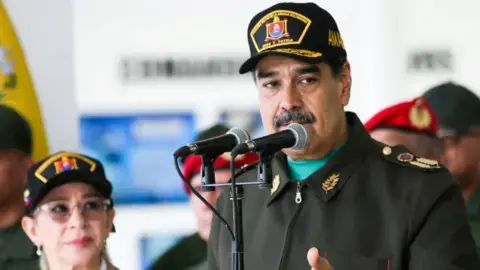
Maduro Opens Door to U.S. Drug Talks, Signaling Thaw in Venezuela Relations
Facing economic collapse, Maduro offers rare cooperation with Washington on drug interdiction, raising hopes—and doubts—of a diplomatic thaw.
A Surprise Overture From Caracas
Caracas—In a late-night address broadcast nationwide, President Nicolás Maduro leaned toward the camera and did something Washington hasn’t heard in years: he offered to talk.
"Venezuela is ready to sit at the table with the United States and discuss drug trafficking," Maduro said, his tone softer than the usual anti-Yankee rhetoric that has defined his decade in power. "The poison of narcotics hurts our people too."
Why Now?
Three U.S. officials, speaking on condition of anonymity, told The Sentinel that back-channel messages began circulating weeks ago after a record cocaine seizure in the port of La Guaira. More than 7.6 tons were hidden in containers of Venezuelan cocoa bound for Europe—an operation U.S. intelligence insists was green-lit by elements inside the Bolivarian National Guard.
One official put it bluntly: "We’ve seen this movie before; Caracas needs sanctions relief and they’re using the drug card."
The Prisoner Factor
Behind the scenes, diplomats say Venezuela wants something tangible in return: the release of Alex Saab, the Colombian businessman extradited to Miami on money-laundering charges and viewed by Maduro as a diplomatic bargaining chip.
"Saab is the key that could unlock everything," a European envoy told reporters. "Maduro’s survival calculus is shifting."
What Washington Might Accept
- Renewed DEA access to Venezuelan airspace and ports
- Joint interdiction patrols in the Caribbean corridor
- Extradition of high-level cartel facilitators operating from Venezuelan soil
The Street Reacts
In the 23 de Enero barrio, where murals of Hugo Chávez still dominate, skepticism runs deep. "Every year they say things will change, but my grocery bill keeps doubling," said Yuleima Pérez, 42, clutching a government ration bag. "If talking to the gringos stops the coke from flooding our streets, then do it."
What Happens Next
State Department spokesman Vedant Patel confirmed "exploratory conversations" but warned that any cooperation hinges on "concrete steps, not headlines." Translation: Maduro must first free at least six detained Americans whom the U.S. considers wrongfully imprisoned.
Still, the mere prospect of cooperation has jolted regional capitals. Colombia’s leftist President Gustavo Petro welcomed the shift, tweeting that "peace in the neighborhood requires all neighbors at the table." Brazil’s Lula da Silva dispatched an envoy to Caracas within 24 hours.
Sanctions Clock Ticks
Current U.S. sanctions bar American firms from Venezuela’s oil sector, cutting the government off from roughly 90 percent of its pre-2019 revenue. Analysts at Caracas-based Ecoanalítica estimate that a partial rollback could boost crude exports by 200,000 barrels a day within six months—enough to ease the chronic fuel shortages that have triggered riots in western states.
The Storyteller’s Take
History teaches that Venezuela’s revolution negotiates best when its coffers are empty. Tonight, with inflation above 400 percent and black-market dollars scarce, Maduro’s olive branch feels less like ideological surrender and more like economic necessity. Whether Washington trusts the offer will shape not just drug routes, but the fate of 28 million Venezuelans caught in the middle.