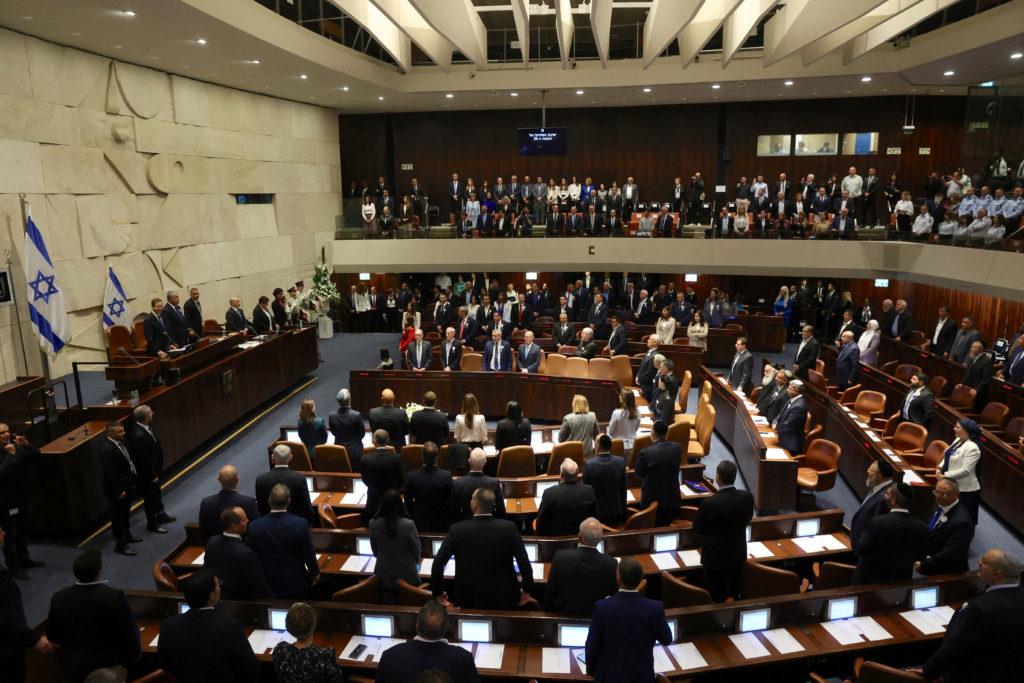
Israel's Death Penalty Dilemma: Weighing Justice and Human Rights
Israel's government is split over the return of the death penalty for Palestinian attackers, sparking intense debates about justice, human rights, and the potential consequences.
Imagine waking up one morning to the news that your government is considering reinstating the death penalty for certain crimes. The debate is heated, with some arguing it's a necessary deterrent and others claiming it's a barbaric relic of the past. This is the reality in Israel, where the government is split over the return of capital punishment for Palestinian attackers.
A Nation Divided
The proposed bill has sparked intense discussions, with proponents arguing that the death penalty will serve as a deterrent against future attacks, while opponents claim it will only perpetuate a cycle of violence. As Dr. Rachel Klein, a criminologist at the University of Tel Aviv, notes,
the death penalty is often seen as a means of retribution, but it rarely addresses the root causes of violence.With the Israeli-Palestinian conflict still simmering, the question remains whether the death penalty will bring about the desired change.
Historical Context
Israel has not carried out an execution since 1962, when Adolf Eichmann, a Nazi officer, was put to death for his role in the Holocaust. Since then, the country has relied on life imprisonment as the maximum penalty for serious crimes. However, the recent surge in Palestinian attacks has led some lawmakers to reconsider the death penalty as a means of combating terrorism.
According to a recent poll, 70% of Israelis support the reinstatement of the death penalty for terrorists, while 25% oppose it.
The Human Cost
As the debate rages on, it's essential to consider the human cost of the death penalty. Families of victims may find some solace in the knowledge that the perpetrator will be punished to the fullest extent, but what about the family of the accused? Do they not deserve justice and due process as well? As Amnesty International's Israel representative, Gilad Gross, points out,
the death penalty is a cruel, inhuman, and degrading punishment that violates the right to life.
International Implications
The potential reinstatement of the death penalty in Israel has far-reaching implications for the international community. Will other countries follow suit, or will Israel be seen as an outlier? The European Union, which has been a vocal opponent of capital punishment, may view this move as a step backward.
The EU's foreign policy chief, Josep Borrell, has stated that the death penalty is abarbaric practicethat has no place in modern society.
A Delicate Balance
As Israel navigates this complex issue, it must balance the need for justice and security with the need to uphold human rights and dignity. It's a delicate balancing act, one that requires careful consideration and nuanced decision-making. Dr. Moshe Cohen, a political scientist at the Hebrew University of Jerusalem, notes that
the death penalty is not a silver bullet; it's a complex issue that requires a multifaceted approach.By examining the experiences of other countries that have abolished or reinstated the death penalty, Israel can learn valuable lessons and make a more informed decision.
Why This Shifts the Global Paradigm
The outcome of this debate will have significant implications for the global community. Will Israel's decision influence other countries to reconsider their stance on capital punishment, or will it be seen as an isolated case? As the world watches, it's essential to consider the potential consequences of this decision. Will it lead to a resurgence of the death penalty worldwide, or will it serve as a catalyst for more nuanced discussions about justice and human rights? Only time will tell, but one thing is certain: the fate of the death penalty in Israel is a watershed moment that will shape the course of history.
As we ponder the future of capital punishment in Israel, we must also reflect on our own values and principles. What does it say about us as a society when we prioritize punishment over rehabilitation and human life? The answer to this question will ultimately determine the path forward, not just for Israel, but for the world at large.
The Kicker
And so, we're left with a profound question: what is the true cost of justice, and are we willing to pay the price? The answer, much like the future of the death penalty in Israel, remains to be seen.