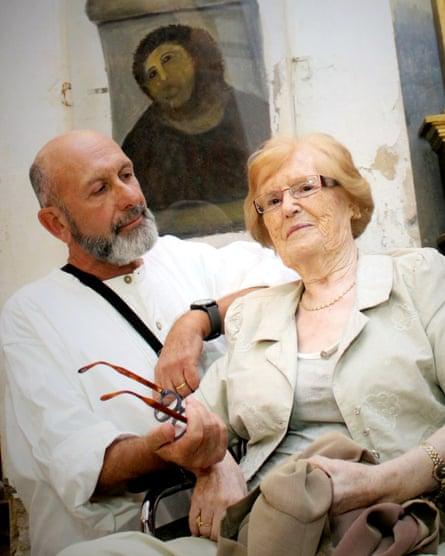
Cecilia Giménez, the Accidental Art-World Icon, Dies at 92
Cecilia Giménez, the Spanish pensioner whose well-meaning restoration turned a fading fresco into the viral "Monkey Christ," has died at 92, leaving behind an unlikely tourism boom and a reassessment of accidental art.
The Woman Behind the 'Monkey Christ'
Cecilia Giménez, the Spanish octogenarian whose earnest attempt to restore a flaking 19th-century fresco became the viral phenomenon known as the "Monkey Christ," died on Sunday night in her hometown of Borja. She was 92. Family members said she passed peacefully, rosary in hand, as the church bells of the Santuario de Misericordia tolled overhead—the same sanctuary where her fateful brushstrokes drew the world's bemused gaze in 2012.
From Devout Parishioner to Accidental Celebrity
For more than half a century, Giménez had volunteered to clean the small chapel. When humidity left Elias Garcia Martinez's Ecce Homo peeling, the retired factory worker took it upon herself to "fix" the portrait of Christ. The result—wide, uneven eyes and a mouth that resembled a startled primate—was mocked, memed and merchandised across the planet. Yet the story did not end in ridicule.
"She simply wanted to help. In the end, she helped more than she ever imagined," said Borja mayor Consuelo Alemán. "Her name put us on the map, and her humility kept us grounded."
A Town Transformed by Tourism
What began as internet schadenfreude evolved into an unlikely lifeline. More than 200,000 visitors have since trekked to the once-sleepy Aragonese town, pumping an estimated €50 million into the local economy. Gift shops sell T-shirts emblazoned with the botched visage; the bar across the plaza offers "Ecce Homo tapas." A portion of every euro raised goes to the Catholic charity Caritas, a stipation Giménez insisted upon once she saw the cash registers ringing.
- Annual visitors rose from 6,000 pre-restoration to a peak of 57,000 in 2016.
- A dedicated interpretation center opened in 2016, charging €3 entry; half of proceeds fund elder-care programs.
- Giménez painted new canvases—mostly floral still-lifes—donated to charity auctions that fetched up to €1,200 each.
Legal Battles and Late-Career Art Shows
While the artist's heirs initially threatened to sue for desecration, the case dissolved when tourism revenues saved several local businesses from bankruptcy. Instead, Giménez was invited to sign limited-edition lithographs alongside the original fresco's reproduction. She donated every cent to a local disability center where her son works.
Final Years in the Spotlight
Despite strokes that limited her speech, Giménez remained a fixture at the chapel's Sunday mass, seated in the third pew, a scarf often draped over her shoulders. Tourists who recognized her requested selfies; she obliged with a toothy grin. Last year Netflix released the documentary "Behold the Monkey," featuring Giménez in a candid interview: "I never sought fame. Fame found me and, like all gifts, you must accept it with gratitude."
Legacy Beyond the Meme
Critics now reassess her handiwork as outsider art—an unfiltered expression of faith and fallibility. The town council voted unanimously to keep the altered fresco intact, arguing that history cannot be whitewashed. Street art in Barcelona has replicated her image as a symbol of accidental reinvention.
Plans are underway for a permanent exhibition titled "Cecilia's Brushstroke," charting the journey from devout parishioner to global conversation piece. A foundation bearing her name will fund art workshops for seniors, ensuring that late-blooming creativity continues to bloom.
She is survived by two children, five grandchildren and a town whose economy—and sense of humor—owes her an unpayable debt.