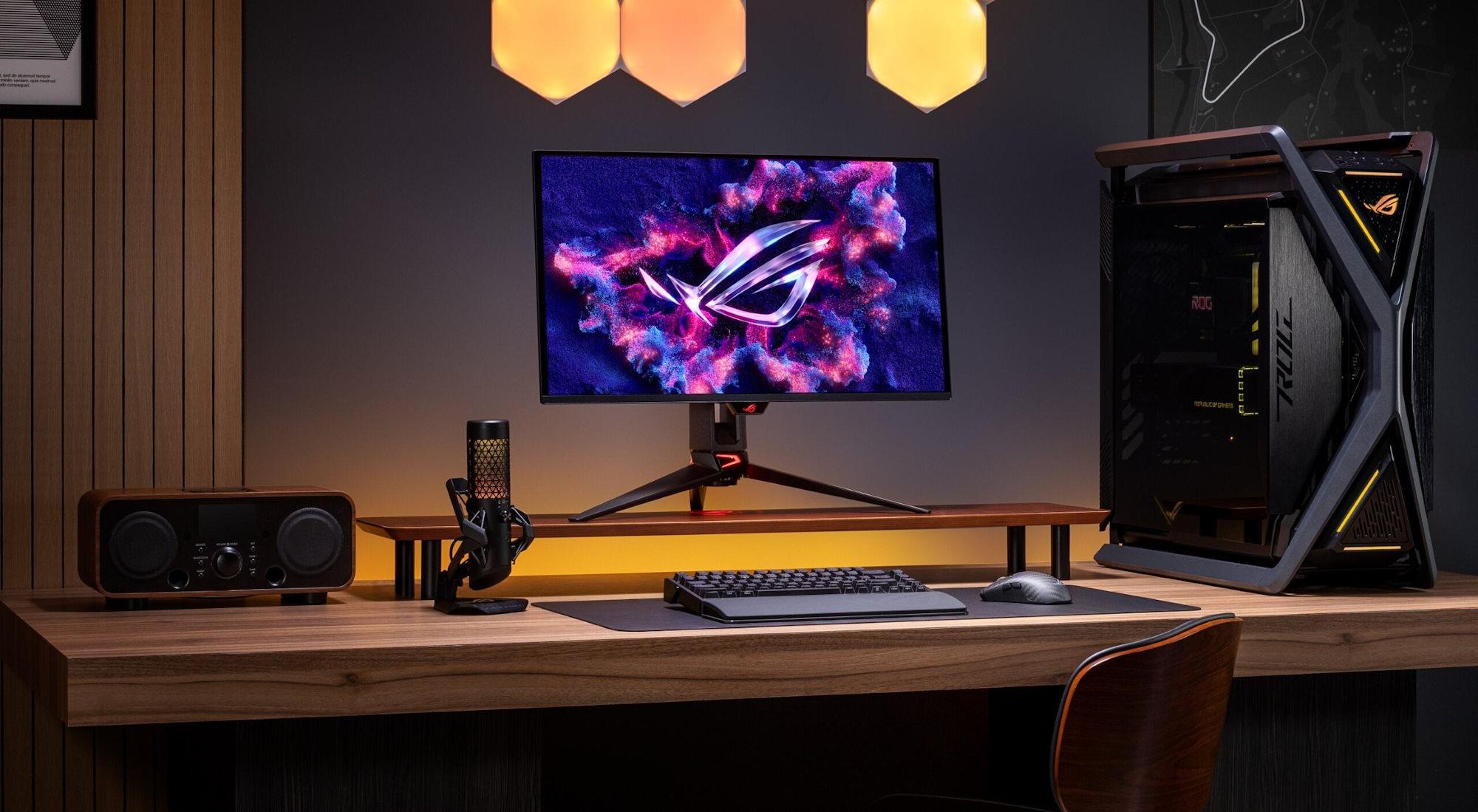
ASUS Unveils Dual OLED Gaming Monitors: 480 Hz Swift & 240 Hz UltraWide Duel for Desktop Dominance
ASUS debuts two flagship ROG Swift OLED monitors—one pushing an unprecedented 480 Hz, the other an 800R curved QD-OLED—setting new bars for speed and color.
A Tale of Two Panels
Las Vegas—The predawn hush of a trade-show hall is a fragile thing. One moment it's velvet-black and silent; the next, a wall of 27-inch and 34-inch screens erupts in neon, shattering the calm. ASUS had promised a reveal, but even seasoned journalists leaned forward when the drapes slid away from the new ROG Swift 4th Gen tandem: the PG27UCWM and PG34WCDN. Two monitors, two OLED philosophies, one unmistakable message—speed and contrast are no longer mutually exclusive.
The Need for 480 Hz
Inside the PG27UCWM beats a tandem OLED layer capable of refreshing 480 times every second. ASUS engineers call it "frame-velocity redundancy"; esports pros simply call it "the end of motion blur." During a live Counter-Strike 2 showcase, a player tracked a pixel-wide flick shot across Dust II's double doors. The audience watched the bullet's trail resolve into a single, razor-thin line—no ghosting, no coronas, just clarity.
“We didn't chase 480 Hz for marketing bullet-points,” said Kevin Chen, Display Product Director. “We chased it because the last remaining barrier in competitive play is the time a pixel spends transitioning from one color to the next.”
UltraWide QD-OLED: Color That Bends Reality
Across the booth, the PG34WCDN's 800R curve cupped the viewer's peripheral vision. Samsung's latest QD-OLED substrate pumps 99.3 % DCI-P3 gamut, but numbers rarely tell the full chromatic story. In a looping HDR canyon demo, sunset oranges bled into indigo shadows without the banding that plagues lesser panels. A photographer standing nearby quietly exhaled the word "inkwell," the old darkroom term for perfect black.
- 3,440 × 1,440 resolution at 240 Hz
- 0.03 ms gray-to-gray response
- VESA DisplayHDR True Black 500 certification
- Custom heatsink vapor-chamber cooling—no active fan
Price, Ports, and the PC You’ll Need
Neither monitor is destined for bargain bins. ASUS confirmed U.S. MSRPs of $1,599 for the PG27UCWM and $1,899 for the PG34WCDN, with global rollouts beginning next quarter. Both carry dual HDMI 2.1 and DisplayPort 2.1 uplinks, but hitting 480 Hz at 1440p demands a GPU north of an RTX 4080 or RX 7800 XT. Early adopters will also need to toggle DSC (Display Stream Compression) unless they're riding the PCIe 5.0 bandwidth train.
The Bigger Picture
Panel partners whisper that tandem OLED yields are still finicky; each PG27UCWM requires two emission layers perfectly aligned to within 1.5 µm. Yet ASUS is betting that esports leagues and affluent enthusiasts will pay the premium for the same reason racers buy carbon fiber: when milliseconds monetize, physics is the final paywall. Meanwhile, the QD-OLED camp—spearheaded by Samsung and now embraced by ASUS—argues that immersive color, not raw hertz, will drive the next upgrade cycle among streamers and content creators.
Back on the show floor, the demo pods cycle through trailers and game loops. A teenager in a Team Liquid hoodie approaches the PG27UCWM, palms sweating. He flicks the toggle from 240 Hz to 480 Hz, moves the mouse, and grins as if he's just felt the future whiz past his fingertips. Somewhere in the crowd, a journalist scribbles a note: "The refresh-rate wars aren't over—they've just gone OLED."